
Vocabulary paper for 2D Design (Art 109) at Shoreline College with Prof. Matt Allison. Based loosely on Edwin A. Abbott's Flatland: A Romance of Many Dimensions.
A line of students drew its way into the main gallery of the prestigious National Gallery of Flatland, following closely behind their docent, a bold and short instructor of Impressionistic Design who went by the title Professor Stout. Stout dashed towards the center of the next display on their itinerary and stood upon a blue-green field of gouache while motioning for silence.
“As we have experienced, the curious images in this wing have been collected from what we believe are three-dimensional beings who attempted in their own crude ways to imagine what life might be like here in Flatland,” lectured Stout gesturing at the scene on all sides of them. The students nudged up against one another for a better view of the landscape that unfolded around them.
“Here, we witness these beings engaged in play at some sort of game. Feel free to flow along the paths as I describe them, students. Immerse yourself in the image and imagine yourself a part of their three-dimensional world, containing up and down as well as the to and fro and back and forth that we in Flatland are all so very familiar with,” encouraged Stout, gesturing at the scene composed of familiar fields of hue, line, and shape so similar to the ones in which the students had spent their formative years frolicking and learning in while attending their Flatland public schools.
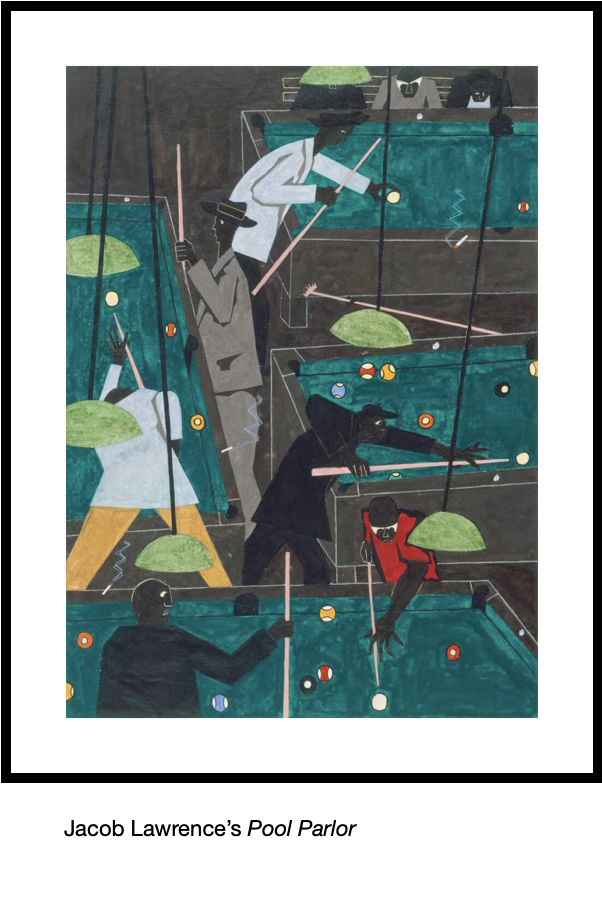
Professor Stout shimmied toward a prominent dark field — one of several — that curled around the lone deeply-red shaded shape that huddled in the corner of the expansive field of jumbled shapes on an even darker analogous brown background.
“This, I think you’ll find, is where the images draws us,” narrated Stout. “Follow along if you will, whether you glide along the thin black and tan highways that lead you fro and to; or traipse among the olive-tinted half-circles, whose repetition transports you hither and yon; or across the deep-verdant trapezoids they cast their flatness upon. You will end up back here, each and every time. It is inevitable.”
As all Flatlanders know, red is the color of judgment that appears on life’s page at the end of the day, highlighting our errors and marking our successes. “Red must be meaningful to these extra-dimensional creatures as well,” surmised Slim Sally Sliderule.
“But it’s not the only red, there are others, but this one seems special. The red form is placed next to and within its complement, the green; so that the hue contrast is highest there,” mused Tiny Tommy Thinness.
Professor Stout bulged, “It’s the scale of it, as well. That’s what sets it apart from the minor red relics.”
“What sort of game were they playing, these creatures?” asked Wispy Wilma Willow curiously.
Stout lengthened stride and drew them towards the shaded figure at the far end of the image. “Do you see how the monochromatic mid-range value shape extends a light-value rectangle, and dark-value appendage toward the subtly yellow-tinted but lighter-value circle?”
The students nodded in unison.
Professor Stout continued, “It is believed that this circle was no mere circle, but instead, a sphere.”
The students gasped.
“That’s right. Here we have evidence before us that these creatures interacted with spheres. As those of you who remember your science studies will recall, it is hypothesized that some circles and ellipses in Flatland could indeed be what in the third-dimension would be called shadows, cast by these theoretical three-dimensional objects. These circles are thought to be mere representations of mythical spheres. Notice also the thick, tapered tan lines that extend from and engage with the creatures and often run parallel to the thicker rectangles that end in concave dark-value shapes. Some suggest that these lines interact with the spheres over time, so as to propel them about along the plane of the verdant rectangles.
You’ll notice the circles are not uniformly distributed along them, but each one is uniquely placed on the rectangle, and that many of these tan lines are extended towards the spheres, or what we presume could be spheres, though they are not represented as spheres in the image here,” finished Sprout.
The students, speechless, seemed to be struggling to take it all in.
Stout extrapolated, “That’s right, not only is this image representative of a theoretical third dimension heretofore unknown to two-dimensional inhabitants of Flatland, but the scene depicted here likely extended beyond the confines of the image itself. Some theorists even suggest that the pure black half-circles at the edges of the verdant trapezoids are holes that lead deeper into the third dimension, though of course, this is a fringe theory.
“There is here yet more evidence of the phenomena the great physicist Evenly Etched Einenmug posited: a focal plane, that would exist if an observer were to be positioned above a scene and viewing it as it might appear when these elements are not all evenly distributed along the flat plane as they would be in Flatland, but distributed above and below in the theoretical third dimension.
“In this arrangement, the focal plane was literally flattened by the artist’s skill in arrangement, or foreshortening of shape — which is what makes it so accessible to young Flatlanders and why it takes up such a prominent position in our collection,” explained Stout. “The artist, Jacob Lawrence, must have had quite the dexterous mind, to be able to live in a complex three-dimensional world and to portray it so vividly to Flatlanders who were likely no more than a whimsical thought experiment to him, just as his kind once were to us.
“To a third-dimensional being, one does not move merely through a scene as a Flatlander does, but above and below it as well. Which is what makes this image so striking: that Lawrence was able to translate that multi-dimensional layering into visual language that everyday Flatlanders can enjoy on every level.” Stout chuckled to himself while delivering the pun.
Several of the more clever and attentive students groaned. They were bunched up together amidst the display, admiring the thin, almost invisible, white lines that framed the verdant trapezoids and the the squiggles that emanated from the thin white rectangles that were arrayed on their edges and detailed the scene with a sense of movement in the stillness.
“These creatures must have been very brave, to live in such a dangerous world. Filled with shapes that we can barely comprehend, and yet are so eerily familiar,” whispered Bright Blue Billy.
“Indeed,” agreed Professor Stout. “These creatures depicted here may seem much like Flatlanders, but their three-dimensional world must have been very different than ours.
“And yet, I see them as joyful. Some have smiles on their faces, and they are engaged in play — though perhaps an intense sort of play. They are among others like themselves and in community, and though we cannot comprehend the nature of their game, it does not appear to be a violent one.
“All told, they appear — from all that is in evidence and from which we can deduce — to be at peace with themselves and one another.”
And with that last declaration, Professor Stout led the students once more along the variegated lines, between the curves and rectangles, and off the boundary of the image and into the next exhibit of the magnificent National Gallery of Flatland.